

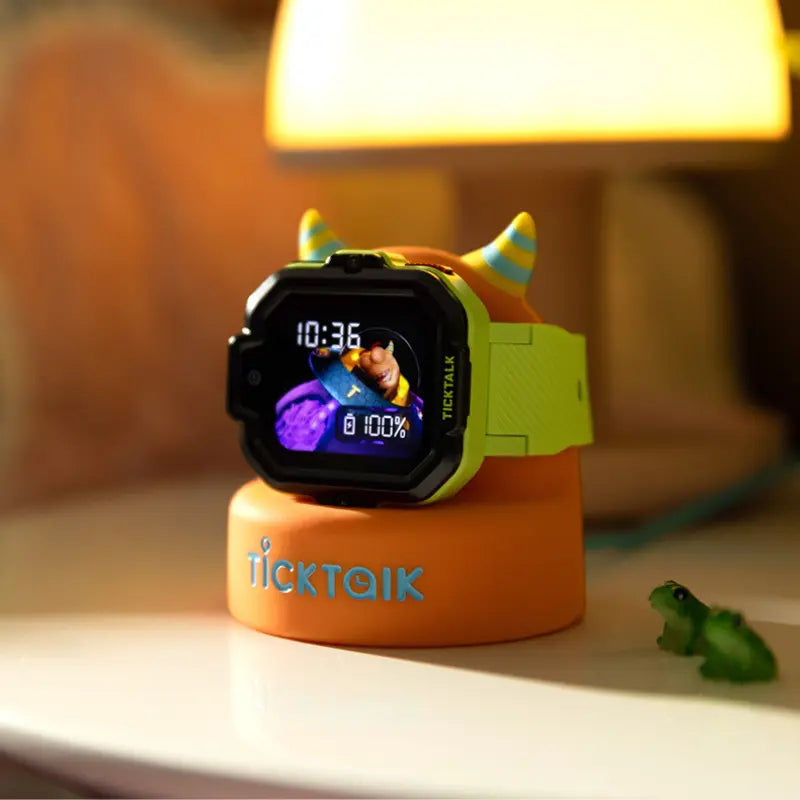
Your child's first device is not just a gadget. It is a decision that shapes how they interact with technology, who they communicate with, and how much independence they gain before they are ready for it. As children are receiving connected devices at younger and younger ages, the type of device matters enormously. This guide examines why smartphones fall short for young kids, what parents should look for in a first device, and how kids smartwatches, especially TickTalk 5, are designed to meet exactly the right needs at exactly the right time.
Why a Child's First Device Is More Important Than Most Parents Realize
The first connected device a child uses sets the tone for their entire relationship with technology. Parents often face pressure to give kids a device for safety reasons, to stay in contact when kids are at school, at a friend's house, or in an after-school activity. But handing a young child a full smartphone to solve that problem introduces a whole new set of challenges. The device a parent chooses defines what their child can access, who can reach them, and how much oversight a parent actually has. Getting it right the first time matters.
The Problem with Smartphones as a First Device
Smartphones are powerful, capable, and designed for adults. When given to young children, they open doors that most parents would prefer stay closed for a few more years. Here are the core concerns parents face when considering a smartphone for a young child:
- Unrestricted Internet Access: A smartphone with internet access puts the entire web within reach of a child who may not yet have the judgment to navigate it safely.
- Social Media Exposure: Most social media platforms set a minimum age of 13, yet account creation is easily bypassed. Young children on social platforms can encounter content and interactions that are developmentally inappropriate.
- Games and Addictive App Design: Mobile games are engineered for engagement and retention, making it difficult for children and parents to manage screen time effectively.
- Unknown Contact Risk: Smartphones with open messaging apps can receive texts, calls, or messages from unknown contacts, making it difficult for parents to know who their child is communicating with.
These are not hypothetical concerns. A 2025 Pew Research Center survey found that about 68% of parents think children should be at least 12 years old before owning a smartphone. Yet despite this, many children are receiving devices years before that age. The gap between when parents feel kids are ready and when kids are actually getting devices is widening every year.
Kids Are Getting Devices Earlier Than Ever
The age at which children receive their first connected device has dropped steadily. Recent Common Sense Media research found that nearly 1 in 4 children age 8 and under already have their own cellphone. Around 53% of 11-year-olds and 69% of 12-year-olds have their own smartphone, making age 11 to 12 a common first-phone window. This means millions of young children are navigating connected devices before they have developed the maturity to manage unrestricted access responsibly. The solution is not to delay connectivity entirely. Children and parents genuinely benefit from being able to reach each other. The key is to choose the right type of device for the child's age and needs.
What to Look for in a First Device for Your Child
When evaluating a first connected device for a child between the ages of 3 and 12, parents should focus on features that serve communication and safety without opening the door to distractions and risks. TickTalk 5 was designed with exactly this framework in mind, and it provides a useful benchmark for evaluating any device in this category.
Key Features for a Safe First Device
- No Internet Access: The device should not be able to browse the web. Internet access opens a child to inappropriate content, advertising, and unsafe interactions without a parent's knowledge.
- No Social Media or App Store: Devices with access to app stores or social platforms give children the ability to install software parents have not reviewed or approved.
- No Games Designed for Addiction: Some educational or movement-based games can be appropriate; however, open access to games designed for extended engagement is not well-suited to a young child's first device.
- Parent-Controlled Contact Lists: Only approved contacts should be able to call, text, or video chat with the child. Unknown numbers should be automatically blocked.
- Real-Time GPS Location: Parents need to be able to see where their child is throughout the day, with accurate and reliable location updates.
- SOS and Emergency Calling: Children should be able to alert a parent or reach emergency services with minimal steps in an urgent moment.
- Two-Way Communication: The value of a child's device is the ability to stay in touch. Voice calls, video calls, and messaging should all be possible, within the boundaries parents control.
- Durable, Wearable Design: A device a child can wear on their wrist is harder to lose and easier to use than a handheld device.
TickTalk 5 includes over 40 parental controls, including contact whitelisting, app user permission settings, screen time management, and remote shutdown. Combined with zero access to internet, social media, or downloadable apps, TickTalk 5 checks every box on this list and sets a high standard for the category.
How Parents Use Kids Smartwatches to Stay Connected and in Control
The parents who choose kids smartwatches over smartphones are making a deliberate trade: they are prioritizing connection and safety over open-ended access. Here is how the core features of a well-designed kids smartwatch serve families in everyday life.
Staying in Contact After School: A parent needs to know their child arrived safely and can reach them in minutes. TickTalk 5 supports HD voice calls, video calls, texting with talk-to-text, group chats, emojis, and photo sharing, all without needing a smartphone and all within a parent-controlled contact environment.
Knowing Where Your Child Is: The watch uses a three-layer location system (Wi-Fi, GPS signal, and cellular tower triangulation) to provide real-time tracking, history routes, and SOS alerts. TickTalk 5 is the first kids' smartwatch in the U.S. to feature AI-powered SmartPin location correction, which learns and improves GPS accuracy over time. As with all GPS-based systems, accuracy varies by environment.
Controlling Who Can Reach Your Child: Every call, every message, and every video chat on the watch is restricted to contacts the parent has manually approved through the free TickTalk Parental Control App. No approval means no contact, in either direction. Unknown numbers are automatically blocked, and in-app chat is end-to-end encrypted for an additional layer of security. Note that SMS is not end-to-end encrypted.
Managing School Hours: Parents can enable School Mode, set Do Not Disturb schedules, adjust app user permissions, and remotely manage data settings, all from the TickTalk app, so the watch stays focused during class without cutting off location visibility entirely.
Emergency Situations: The SOS and 911 feature allows quick emergency calls and sends instant location alerts to parents, reinforcing a commitment to safety in urgent moments. The 911 quick-dial is a U.S.-only feature. TickTalk 5 also includes a Remote Answer feature: when activated, the watch calls the parent back within one minute with the parent's end muted, allowing them to hear their child's surroundings.
Keeping It Fun Without the Risks: TickTalk 5 includes an activity tracker, step goals, 3D reminders, and free kid-friendly music streaming powered by iHeartRadio Family (U.S. only), as well as a calculator, calendar, timer, stopwatch, photo filters, animated GIFs, and e-greeting cards, without games, social media, or app downloads.
TickTalk 5 earns a 4.8-star average product rating and has been featured by Forbes Vetted, USA Today, Parents.com, and ABC News, reflecting strong independent validation of its approach.
Competitor Comparison: Kids Smartwatches for Child Safety and Communication
The table below provides a quick side-by-side comparison of the leading kids smartwatches on the market today. It covers the dimensions that matter most to parents making a first-device decision: communication features, safety controls, internet and social media access, network flexibility, and pricing.
| Feature | TickTalk 5 | Gabb Watch 3e | Bark Watch | Cosmo JrTrack 5 | Gizmo Watch 4 | Fitbit Ace LTE |
|---|---|---|---|---|---|---|
| No Internet Access | Yes | Yes | Yes | Yes | Yes | Yes |
| No Social Media | Yes | Yes | Yes | Yes | Yes | Yes |
| No Games / App Downloads | Yes | Yes | Yes | Parent-controlled optional apps | Educational games included | Activity-based games built in |
| Video Calling | Yes (FaceTalk) | No | Yes | No | Yes | Yes |
| Real-Time GPS | Yes (AI SmartPin) | Yes | Yes | Yes | Yes | Yes |
| SOS / Emergency Calling | Yes (911 included, U.S.) | Yes | Yes | Yes (911 optional) | Yes | Yes |
| Parent-Approved Contacts Only | Yes | Yes | Yes | Yes | Yes | Yes |
| Parental Controls | 40+ | Limited | AI content monitoring | SafeCORE + parent app | Verizon Family App | School Time + contact limits |
| Network | AT&T or T-Mobile | Verizon only | Carrier-agnostic | Cosmo Mobile | Verizon only | Google (Ace Pass) |
| Age Range | 3-12 | 5+ | 7-11 recommended | Not specified | 6-11 | 7+ |
| Watch Price | $159.99 | $149.99 | ~$169 | ~$150 | $179.99 MSRP | ~$230 MSRP |
| Monthly Plan | From $9.99/mo + tax | $12.99-$17.99/mo + $30 activation | $15/mo | From $9.99/mo equivalent (prepaid) | $10/mo + Verizon plan | $9.99/mo (Ace Pass) |
| Water Resistance | IP67 | IP68 | IP68 | IP68 | Water-resistant | Water-resistant |
| Free U.S. Shipping | Yes | No | No | No | N/A | No |
| No Activation / Cancellation Fees | Yes | No ($30 activation) | No | No (small activation fee) | Varies | No |
While several competitors in this category take a safety-first approach to internet and social media access, TickTalk 5 stands apart by combining the richest two-way communication feature set, including FaceTalk video calling, with the broadest parental control suite (40+), the most network flexibility (AT&T or T-Mobile), and the most accessible entry-level plan at $9.99/mo with no activation or cancellation fees. For parents looking for a first device that does exactly what a child's device should do and nothing more, TickTalk 5 delivers the most complete answer.
The Best Kids Smartwatches for Safety and Communication in 2026
1. TickTalk 5
TickTalk 5 gives kids the independence they crave, with HD calling, real-time GPS, and 40+ parental controls, all without social media, browsers, or addictive apps. It is the flagship kids smartwatch from TickTalk, designed for children ages 3 to 12, and it has been recognized by SafeWise as the 2026 Best Battery Life Winner in the Kids Safety Awards. It holds a 4.8-star average product rating and is the only kids smartwatch in the U.S. with AI SmartPin location correction. It runs on either AT&T or T-Mobile networks via TickTalk Wireless (U.S. only).
Key Features:
- FaceTalk Video Calling: TickTalk 5 is a standalone 4G LTE kids smartwatch that supports voice and video calling through Wi-Fi or cellular data, equipped with a 5MP front camera for smooth, HD-quality video calls with parent-approved contacts.
- 40+ Parental Controls: Parents can manage contacts, block unknown callers, view call logs, adjust app user permissions, manage screen time, enable School Mode, set Do Not Disturb schedules, and even trigger a remote shutdown from the TickTalk app.
- AI SmartPin GPS: TickTalk 5 is the first kids' smartwatch in the U.S. to feature AI-powered SmartPin location correction, which provides real-time tracking, history routes, and SOS alerts while learning and improving accuracy over time. Accuracy varies by environment.
- SignalBooster Technology: Unlike other kids' smartwatches, TickTalk 5 integrates its antenna into the watch strap, delivering 20% better signal strength and smartphone-level cellular connectivity.
- ScreenSafe Design: Engineered with an under 1% break rate to reduce screen damage during active play.
- T-Cloud: Backs up your child's watch data securely to the cloud.
- tOS: TickTalk's proprietary operating system, optimized for kids and updated continuously for stability and new features.
TickTalk 5 Safety and Communication Offerings:
- Approved-contacts-only calling, texting, video calling, voice messaging, and group chats
- Real-time GPS with route playback and multi-technology tracking (accuracy varies by environment)
- SOS alerts and 911 quick-dial (U.S. only)
- Remote Answer feature for ambient listening in emergency situations
- In-app chat with end-to-end encryption (SMS is not encrypted)
- iHeartRadio Family music streaming (U.S. only)
- Activity tracking, step goals, and wellness tools
- No internet, no social media, no app store, no games, no downloads
Pricing: Watch: $159.99. TickTalk Wireless plans start at $9.99/mo + tax with no contract, no activation fees, and no cancellation fees. Free U.S. shipping included. 1-year limited warranty. 30-day returns.
Pros:
- No internet, social media, games, or app downloads, by design
- 40+ parental controls with granular contact management and remote shutdown
- FaceTalk video calling included
- AI SmartPin is the first of its kind for kids' smartwatches in the U.S.
- Network choice: AT&T or T-Mobile (not locked to a single carrier)
- No activation or cancellation fees
- SafeWise 2026 Best Battery Life Winner
- 4.8-star average product rating
- Featured by Forbes Vetted, USA Today, Parents.com, and ABC News
- Up to 100+ hours standby; IP67 water-resistant
- Designed for ages 3 to 12, the widest age range in this comparison
Cons:
- Available in the U.S. only (TickTalk Wireless, 911 calling, iHeartRadio Family, and free shipping are U.S.-only features)
- No open app ecosystem for parents who want optional third-party content
TickTalk 5 is the most complete, kid-safe smartwatch on the market in 2026. It does not try to be a smartphone. It is a purpose-built communication and safety device, and that intentionality is its greatest differentiator. Shop TickTalk 5 at myticktalk.com.
2. Gabb Watch 3e
The Gabb Watch 3e is a kids' smartwatch from Gabb Wireless focused on safe technology for children. It offers GPS tracking, calling, texting, and SOS functionality without internet or social media access. The Gabb Watch 3e only works on Verizon, while TickTalk 5 supports both AT&T and T-Mobile, giving families greater carrier flexibility.
Key Features:
- GPS tracking with Safe Zone alerts
- Calling and texting with parent-approved contacts
- SOS emergency button
- IP68 water resistance with Gorilla Glass 3 scratch protection
- Fitness tracking with step counter and Gabb Go rewards
Safety and Communication Offerings:
- Parent-managed contact list via the MyGabb app
- No internet or social media
- Safe Zone geofencing with parent notifications
- Speech-to-text messaging
- No video calling capability
Pricing: $149.99 for the device. Monthly plans range from $12.99 to $17.99/mo, plus a $30 one-time activation fee.
Pros:
- No internet or social media access
- IP68 water resistance and Gorilla Glass durability
- Fitness rewards via Gabb Go
- Clean, simple interface well-suited to younger kids
Cons:
- No video calling
- Verizon network only, limiting carrier flexibility
- $30 activation fee adds to initial cost
- More limited parental controls compared to TickTalk 5's 40+ options
- Monthly plan costs are higher than the TickTalk Wireless starting rate
3. Bark Watch
The Bark Watch is a kids' smartwatch from Bark Technologies, a company known for its AI-powered content monitoring platform. Its primary differentiator is automated content monitoring that scans texts, photos, and videos for potential safety concerns and sends parent alerts. It is generally best suited for older children in the 9 to 14 age range.
Key Features:
- AI-powered content monitoring across texts, photos, and videos
- Real-time GPS location tracking
- SOS button for emergencies
- Calling and video calling with parent-approved contacts only
- No internet access, no social media, no browser
Safety and Communication Offerings:
- Automated parent alerts for potential concerns detected in messages and media
- Contact management through the Bark parent app
- 24/7 GPS location tracking
- Bark Premium subscription for all family devices included
Pricing: Approximately $169 upfront, plus $15/mo for service and parental controls.
Pros:
- AI content monitoring is a distinctive safety feature
- No internet or social media access
- Includes Bark Premium for monitoring other family devices
- GPS tracking with SOS functionality
Cons:
- Higher monthly cost than TickTalk Wireless starting plan
- Best suited for older children; less aligned with the early-age use case TickTalk 5 serves (ages 3 to 12)
- Relies on reactive AI alerts rather than proactive contact-gating as the primary protection layer
- Monthly plan required even after the device is fully paid off
4. Cosmo JrTrack 5
Cosmo's JrTrack 5 is a kids' smartwatch from Cosmo Together, a brand emphasizing affordability and safety. It runs on Cosmo Mobile, a family-safe proprietary network, and features a SafeCORE four-front safety system. Parents can select optional kid-safe apps and music, fully administered and removable at any time, with daily time limits available.
Key Features:
- SafeCORE safety system: Safe Zone alerts, optional 911 calling, SOS mode, and trusted contact firewall
- Real-time GPS tracking with custom geofence zones
- Calling and texting with parent-approved contacts
- Optional parent-administered apps and music
- IP68 water resistance
Safety and Communication Offerings:
- Approved-contacts-only communication with unknown number blocking
- Geofence-based Safe Zones with check-in alerts
- SOS double-tap button
- School Settings for distraction-free class time
- Optional kid-safe apps and content, parent-controlled with time limits
Pricing: Plans range from $19.99/mo on a flexible month-to-month basis, with prepaid options equivalent to as low as $9.99/mo on a 2-year plan. A one-time $14.99 activation fee applies to all new lines.
Pros:
- Competitive pricing on prepaid plans
- SafeCORE multi-layer safety system
- Optional apps are fully parent-administered
- IP68 water resistance
- FlexSIM technology for multi-network coverage
Cons:
- Optional games and apps introduce content considerations that fully locked-down watches avoid
- No video calling
- Proprietary Cosmo Mobile network may have different coverage characteristics than major U.S. carriers
- Monthly costs vary significantly based on contract length chosen
5. Gizmo Watch 4 (Verizon)
The Gizmo Watch 4 is Verizon's latest entry in its kids' smartwatch lineup, launched in July 2026. It is designed to give parents and guardians peace of mind through next-level safety features, including Watch Removal Detection alerts, real-time location insights, and incoming severe weather notifications. It requires a Verizon plan, limiting it to families on or willing to switch to the Verizon network.
Key Features:
- Real-time GPS location with custom Safe Zones
- Watch Removal Detection alerts
- Video calling with parent-approved contacts
- 1.6-inch scratch-resistant screen
- Up to three days of battery life
Safety and Communication Offerings:
- Calling, texting, or video chat with up to 40 parent-approved contacts
- No social media or web browsing
- Safe Zone geofencing via Verizon Family app
- Educational features, step counter, and to-do lists
Pricing: MSRP $179.99 plus a $10/mo watch line fee on Verizon. Promotional pricing available with a new line on a 36-month payment plan.
Pros:
- Verizon network reliability
- Watch Removal Detection is a unique safety alert feature
- Up to 40 parent-approved contacts
- Up to three days of battery life
- Video calling supported
Cons:
- Requires Verizon network, not available on AT&T or T-Mobile
- 36-month payment commitment for promotional pricing
- Verizon plan requirement adds to total monthly cost
- Fewer parental control options compared to TickTalk 5's 40+ controls
- Higher MSRP than most competitors in this category
6. Fitbit Ace LTE (Google)
The Fitbit Ace LTE is Google's entry into the kids' smartwatch space, designed for children ages 7 and up. It emphasizes fitness and movement through activity-based games in the Fitbit Arcade, where physical movement drives in-game progress. It supports calling, messaging, and GPS, and requires an Ace Pass data plan to unlock its full feature set. Games are a central design element, which may not align with all parents' preferences for a first device.
Key Features:
- Activity-based games in Fitbit Arcade (movement required to progress)
- GPS location tracking with 4G LTE connectivity
- Calling and messaging with parent-approved contacts
- School Time feature to limit gameplay during class hours
- OLED touchscreen display
Safety and Communication Offerings:
- No ads and no third-party apps; only parent-approved contacts can call or message the device
- Real-time GPS location sharing via the Fitbit Ace app
- School Time to pause games and calls during class
Pricing: MSRP approximately $229.95, with frequent discounts. The Ace Pass, required to unlock calling, texting, and GPS tracking, runs $9.99/mo.
Pros:
- Activity-based games encourage physical movement
- Sleek, durable OLED design
- Parent-managed contacts and School Time controls
- GPS and calling with Ace Pass
- Google-backed platform with regular updates
Cons:
- Games are a central, built-in feature, not optional
- Highest upfront cost of any device in this comparison
- Most core features require the Ace Pass subscription
- Not positioned primarily as a safety-first device
- Game-centric design may not align with families seeking a fully distraction-free first device
Evaluation Rubric for Kids Smartwatches as First Devices
When choosing a child's first connected device, parents should weigh several criteria. Not every device excels in every area, and the right balance depends on the child's age, maturity, and the family's priorities. The rubric below reflects what most parents prioritize when their child is in the 3 to 12 age range.
| Evaluation Category | Why It Matters | Relative Weight |
|---|---|---|
| Safety Controls and Contact Management | Determines who can reach your child and what they can access | 30% |
| GPS and Location Accuracy | Gives parents reliable visibility into their child's whereabouts | 25% |
| Communication Features | Defines how well a parent and child can stay in touch | 20% |
| Absence of Distractions (internet, social, games) | Protects focus and removes inappropriate content risk | 15% |
| Pricing and Plan Flexibility | Determines total cost of ownership and carrier choice | 10% |
No single feature tells the whole story. The best first device for a young child is one that delivers strong performance across all five categories. TickTalk 5 is the only device in this comparison that addresses each category by design: 40+ parental controls, multi-technology AI SmartPin GPS, FaceTalk video calling, a zero-distraction feature set, and the lowest starting monthly plan in the category at $9.99/mo with no activation or cancellation fees.
Why TickTalk 5 Is the Best First Device for Young Children
Every device reviewed in this guide takes child safety seriously. But most of them approach the challenge from a different angle than TickTalk 5. Bark leads with content monitoring. Fitbit Ace LTE leads with fitness gamification. Gizmo Watch 4 leads with the Verizon Family ecosystem. Gabb and Cosmo take clean, simplified approaches, but with feature trade-offs and higher or more variable monthly costs.
TickTalk 5 starts from a different premise entirely: a child's first device should do exactly what a parent needs it to do, and nothing that could get in the way. Children naturally want to stay connected in today's digital world, but that does not mean they need unrestricted access to social media, internet browsing, or downloadable games. TickTalk 5 delivers HD voice and video calling, AI-powered SmartPin GPS tracking, 40+ parental controls, and up to 100+ hours of standby battery, without any social media or internet access. It is the most complete, kid-safe smartwatch available in 2026, and it is trusted by hundreds of thousands of families across the country.
For parents who want to stay connected to their child without handing them a smartphone, TickTalk 5 is the answer. Compare plans from $9.99/mo at myticktalk.com.
FAQs About Kids Smartwatches for Safety and Communication
Why do parents choose a kids smartwatch instead of a smartphone for their child's first device?
According to a 2025 Pew Research Center survey of U.S. parents with children ages 12 and younger, 81% of those whose child has a smartphone say it is to easily contact their child. A kids smartwatch like TickTalk 5 meets that need directly, with calling, FaceTalk video calling, and messaging built in, but without handing a young child unrestricted internet access, social media, or games. It delivers the connection parents need without the risks a full smartphone introduces.
What is a kids smartwatch?
A kids smartwatch is a wearable device designed for children that provides communication, GPS tracking, and safety features without the open-access nature of a full smartphone. TickTalk 5 is a standalone 4G LTE kids smartwatch for children ages 3 to 12 that supports voice calls, FaceTalk video calls, texting, and real-time GPS tracking, all managed by a parent from the TickTalk Parental Control App. It has no internet browser, no social media, and no app store, making it a true smartphone alternative built around what children need and what parents can trust.
What are the best kids smartwatches for safety and communication in 2026?
The leading kids smartwatches in 2026 include TickTalk 5, Gabb Watch 3e, Bark Watch, Cosmo JrTrack 5, Gizmo Watch 4, and Fitbit Ace LTE. Among these, TickTalk 5 stands out for its combination of 40+ parental controls, AI SmartPin GPS, FaceTalk video calling, network flexibility across AT&T and T-Mobile, and the lowest starting monthly plan in the category at $9.99/mo with no activation fees. It is designed for children ages 3 to 12, the widest age range of any device in this comparison.
How does TickTalk 5 prevent unknown contacts from reaching my child?
TickTalk 5 uses a fully closed, parent-controlled contact system. Every call, message, and video chat on the watch is restricted to contacts the parent has manually approved through the free TickTalk Parental Control App. No approval means no contact, in either direction. Unknown numbers are automatically blocked. In-app chat is end-to-end encrypted, though SMS is not. This system means a parent always knows exactly who their child is communicating with, one of the most important features a first device can have.
Is TickTalk 5 waterproof?
TickTalk 5 is water-resistant with an IP67 rating, designed to protect against minor splashes and spills during everyday activity. It is not marketed as waterproof, swim-proof, or shower-safe. IP67 water resistance is appropriate for the active daily use typical of children in the 3 to 12 age range and contributes to the durability parents expect from a device their child will wear throughout the day.
At what age should a child get their first connected device?
This is a question most parents wrestle with. A 2025 Pew Research Center survey found that about 68% of parents believe children should be at least 12 years old before owning a smartphone. But the need to reach a child often arises much earlier, especially for kids walking to school, attending activities, or spending time away from home. A kids smartwatch bridges this gap by giving younger children a way to communicate with family while keeping the parent fully in control. TickTalk 5 is designed for children as young as 3, making it one of the few devices in this category suited to the full span of early childhood through the tween years. It gives children the independence they are ready for and gives parents the peace of mind they need, without the risks that come with a smartphone.
Share:
School Mode for Kids: How to Block Apps and Calls During Class (2026)
TickTalk 6 is here! Pre-Order Now.